

What a sourcing agent should show each customer they are owed
“Did they pay for the last container?” is a question every agent has asked at a desk with three windows open. The payment is in a bank app. The invoice is in a folder. And the money you paid out on the customer's behalf — the hotel while they visited, the sample courier, the local charges you covered — is in nobody's record at all. This guide is about the one statement that ends that.
Money moves in three directions
Between an agent and a customer, over a year of containers, money does three things:
- You charge them — the goods, your commission, the freight and export charges on each order.
- They pay you — deposits, balances, sometimes a round figure "on account" that belongs to no order in particular.
- You pay on their behalf — costs that are theirs but that you settled first, and that no invoice has picked up yet.
A statement that shows only the first two will always be wrong by the third. That third line is the one that quietly disappears in a spreadsheet, and it is the one agents most often never get back.
One statement per customer, across every order
The mistake is keeping money per order. Payments do not arrive per order — a customer sends one transfer against two containers and a debt from last spring. So the statement has to be per customer and run across all their files.
Consolly keeps it that way. Each customer has one balance: what they have been charged, what you paid on their behalf, what they have paid, and what is still owed — worked out from the record, so it is the same figure tomorrow morning as it is tonight.
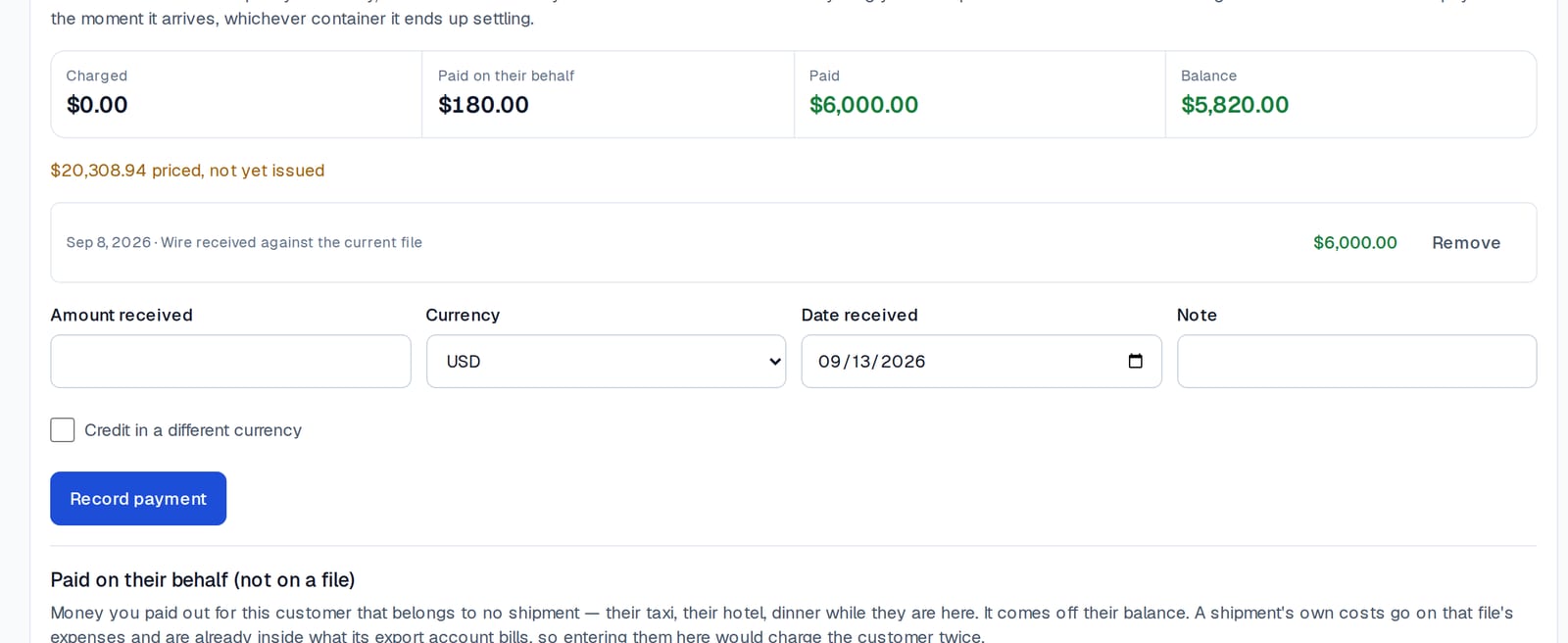
Under the balance, the per-order lines: each order's invoiced amount, what has been received against it, and what is still owed — including the figure that is priced but not yet issued, which is the number that surprises people.
Record the expense the day you pay it
"Paid on their behalf" has its own form, deliberately separate from any order: an amount, a currency, a date and what it was for. It joins the customer's balance at once. A cost recorded the day it is paid is a cost you get back; one remembered at year-end is a story.
A payment in a different currency
Customers pay in the currency they have. A statement in USD can take a payment credited in another currency at the rate you set for it, and the balance stays one figure. Each order also carries its own frozen exchange rate, so the documents on it always add up the same however the market moves.
Where the customer sees it
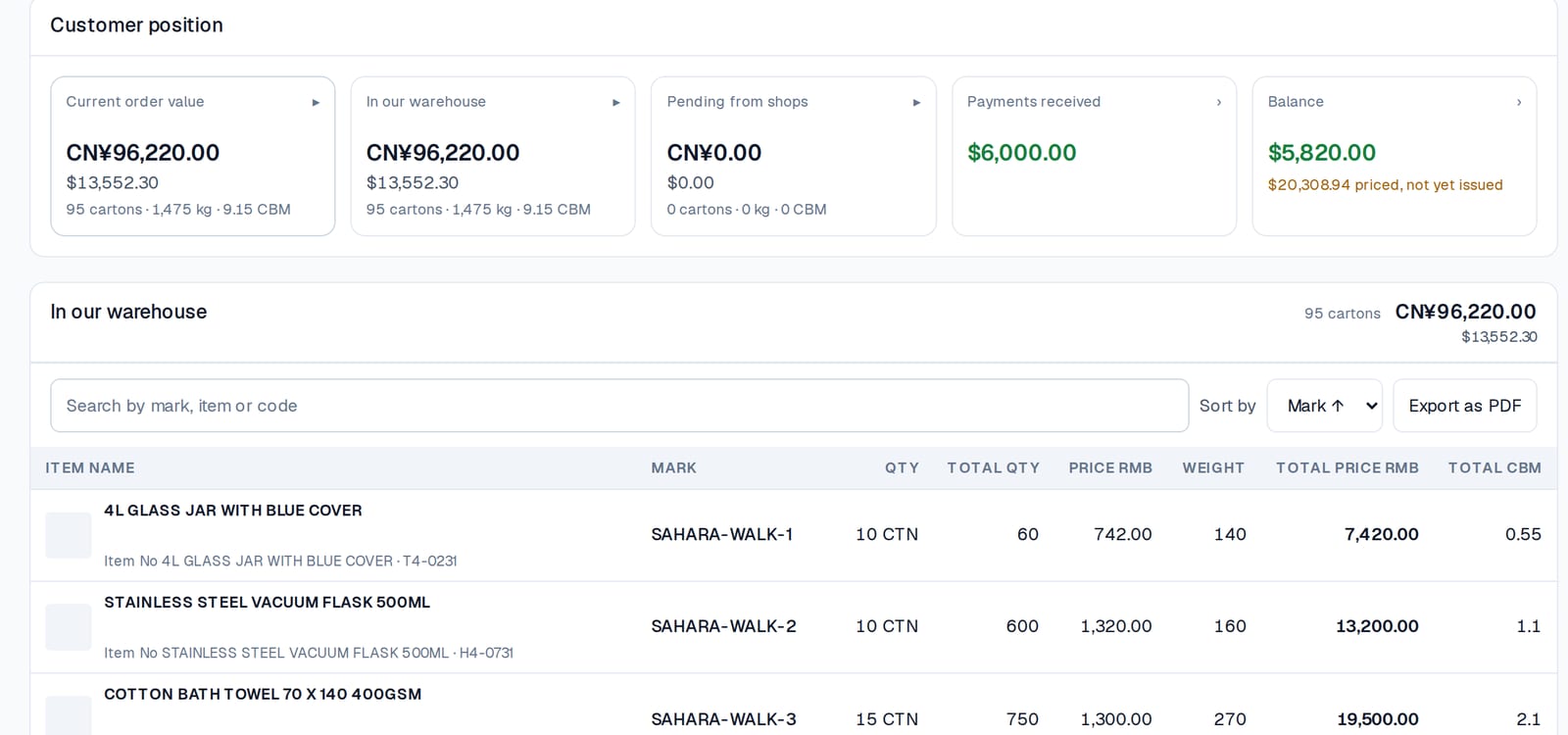
The statement can be printed as a PDF for the customer, and the customer's position — current order value, in the warehouse, pending from shops, payments received, balance — is one screen in the office.
What you decide the customer does not see
None of this shows the customer what you paid the shops. Prices on documents are a choice per order, and the customer's own page shows their order the way you decide it should be shown. The balance is theirs to see; your margin is not.
The three lines, once more
Charged. Paid. Paid on their behalf. Keep the third one, keep all three per customer rather than per order, and “did they pay for the last container?” becomes a figure on a screen instead of a search through three windows.