

Give each customer their own page, so they stop asking
“Any update on my order?” It arrives on WhatsApp, on WeChat, by email and by phone, from every customer, most days. Answering it takes four minutes of looking things up and one minute of typing, and the same customer asks again on Thursday. This guide is about ending it with an address and a password.
What the customer actually wants to know
Not much, and always the same things:
- What of mine have you bought, and from where?
- What has arrived at your warehouse?
- What is in the container, and when does it sail?
- What do I owe you — or what have I paid ahead?
An agent answers those by reading their own screens. The customer's page is those screens, for that customer only, without the agent in between.
One address, one password, every order
In Consolly each customer can be given a page of their own: a short web address ending in a name you choose for them, and a password you hand them once. They open it on a phone, type the password, and see everything you are doing for them: every order being prepared, every one on the water, every carton, and their account with you. No app to install, no email confirmation, nothing for their staff to be trained on.
Why not a link anyone can open
Consolly does not offer a page that opens without a password, and will not. A link is forwarded; a forwarded link ends up in a group chat; and a page that shows what a customer has bought and what they owe is a trading position that must not be in a group chat. The password is the whole point. If it is lost, you set a new one from the customer's record in the office; the old one stops working that second, on every phone that had it.
What they see
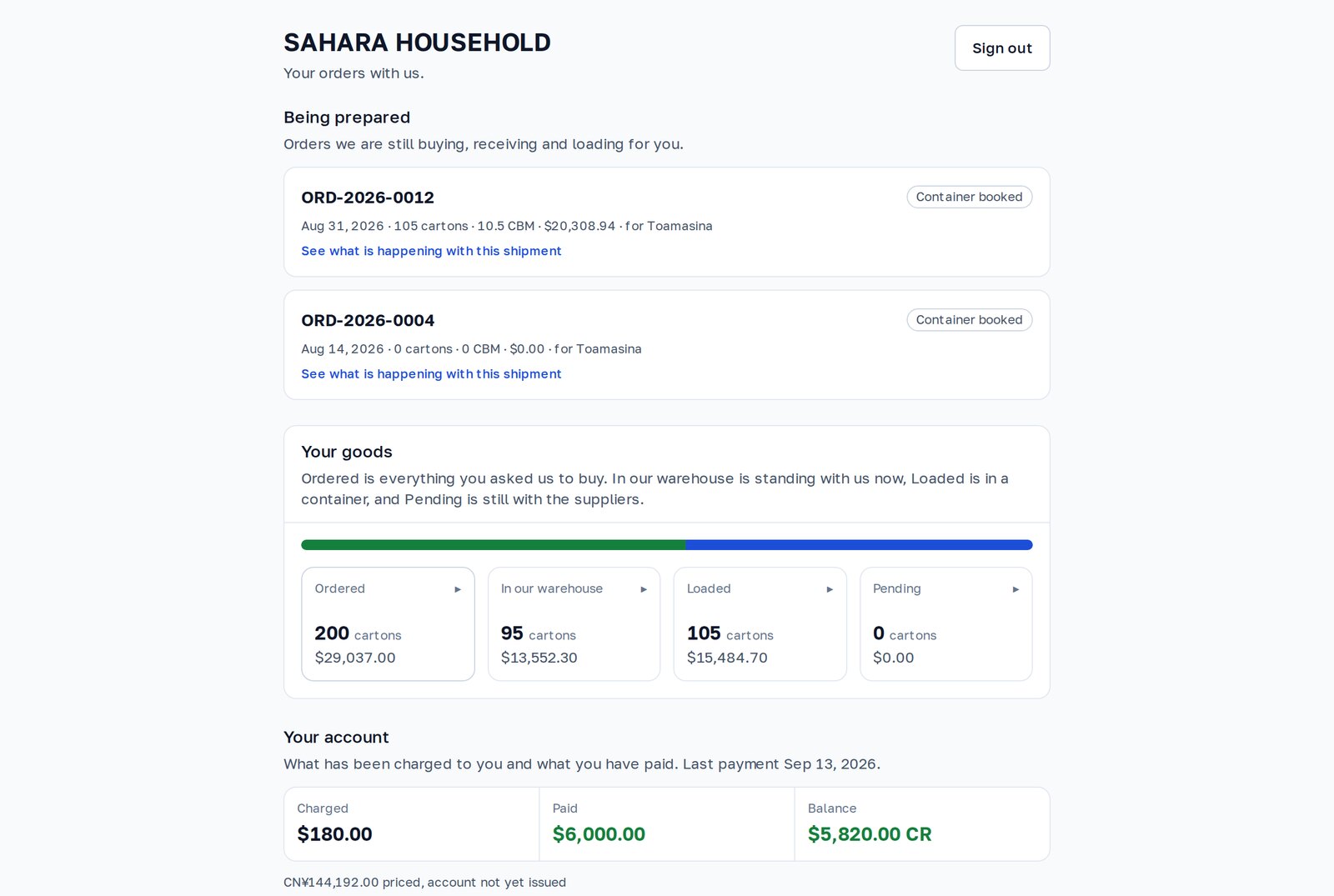
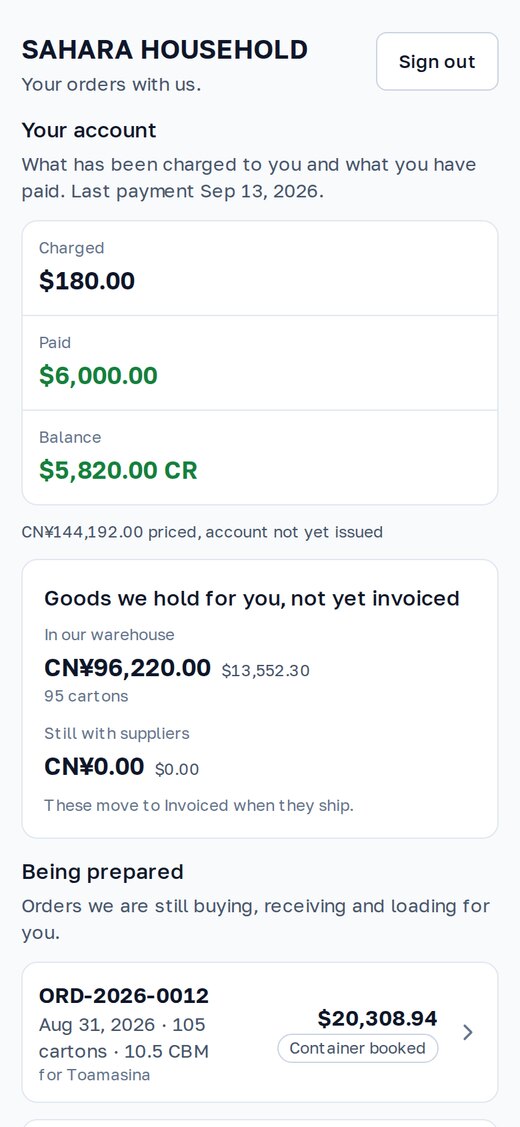
Their orders, in two groups. Being prepared — what you are still buying, receiving and loading, with the container status when one is booked. On the way — what has sailed, with the days left to their port when the shipping line has given a date. Each order opens to its own lines, marks, cartons and photographs.
Their goods in four places. Ordered is everything they asked you to buy; in your warehouse is what is standing with you now; loaded is what is in a container; pending is still with the suppliers. Four numbers that add up, the same four the packing list is written from.
Their account. What you have charged, what they have paid, and the balance — in credit or in debit, in the currency you bill them in. Goods you are holding that have not been invoiced yet are shown separately, so a customer who has paid ahead can see that the money and the goods are both there.
Their documents. The commercial invoice, the packing list and the export account for each shipment, as PDFs, the day you issue them.
What they never see
What you paid the shops. Your margin. Your other customers. Anything from an order that is not theirs. The page is built from your own records, filtered to one customer, and the office decides nothing further — there is no tick-box that can accidentally show a purchase price, because the purchase price is not on the page at all.
Why it changes the day
The customer stops asking, because they can see. The office stops looking things up, because the page is already right. And the record the customer reads is the same record the packing list and the statement are written from, so what they were told, what they are billed and what arrives are the same thing.
If your customers currently ask on chat, the address and the password are the reply you send once.